About Project
Our project introduces robotics as a part of technology education into early childhood settings in three kindergartens located in Poland, Finland, and Slovenia. We aim to enhance early childhood education, promote innovation, foster collaboration between educators and schools, empower teachers with...
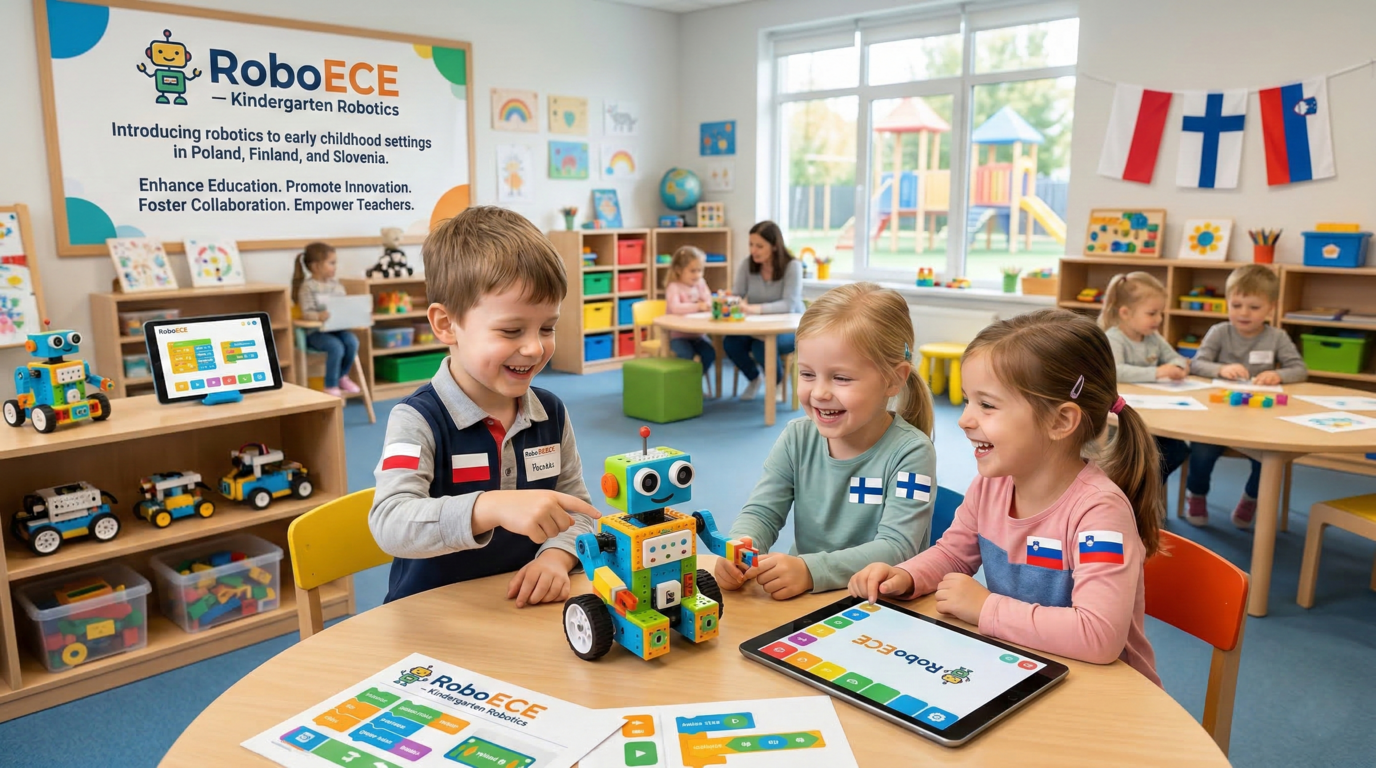
Our project introduces robotics as a part of technology education into early childhood settings in three kindergartens located in Poland, Finland, and Slovenia. We aim to enhance early childhood education, promote innovation, foster collaboration between educators and schools, empower teachers with new skills, and engage and inspire young children to explore the exciting world of robotics. Through collaboration, innovation, and empowerment, we will create a brighter future for young learners.
Project Objectives
- To promote technological education in early childhood.
- To introduce basic robotics concepts to children aged 3–6.
- To strengthen technological confidence, especially among girls aged 3–6.
- Hands‑on robot assembly: Enable children to build simple robots using age‑appropriate materials.
- To introduce the basics of programming through playful, age‑appropriate activities.
- To encourage intercultural understanding and cooperation among children and educators.
- To motivate parents to participate in the learning process and understand the educational benefits of robotics.
- To develop robotics lesson plans for preschool teachers.
- To disseminate information about methods for teaching robotics in kindergartens.
At least 15 robotics lesson plans suitable for preschool will be created. Children aged 3 to 6 will be included. The project objectives address priority areas such as the development of high‑quality early childhood education systems, the early introduction of robotics and STEM concepts, the promotion of gender equality, and the encouragement of hands‑on learning. The purpose of the project is to improve robotics skills, introduce children to STEM concepts, and foster creativity and critical thinking through practical activities.
STEM (science, technology, engineering, and mathematics) Children will develop a range of skills, including critical thinking, problem‑solving, creativity, and digital literacy. Robotics activities provide a playful and hands‑on learning experience. Through play, children engage in problem‑solving, develop critical thinking, and nurture creativity—skills essential for future success. Building and programming robots supports the development of motor skills and cognitive processes. Robotics activities encourage children to use their imagination and creativity.
The project aligns with the need to prepare children for the 21st century by equipping them with skills such as critical thinking, problem‑solving, and digital literacy, which are essential in today’s world. By integrating robotics into early childhood education, the project contributes to long‑term improvements in teaching and learning and serves as a model for incorporating innovative and effective educational methods.
Partners are strongly encouraged to maintain regular communication through multiple channels, including a dedicated WhatsApp group, email correspondence, and scheduled Zoom or other comparable on-line meetings.
First meeting was in Finland, where we planned our project and established a warm and collaborative atmosphere. These interpersonal relationships are crucial for building strong partnerships and a shared understanding of the project's trajectory.
Clear lines of responsibility are established, ensuring that all partners are fully aware of their roles and obligations.
The pre-existing WhatsApp group, established during the application phase, will play a crucial role in maintaining daily communication among partners. Each partner school and team member will be assigned clear tasks related to their involvement in the project, encompassing regular communication, use of eTwinning, promotion and dissemination of activities outcomes, sharing ideas, and joint planning of partnership strategies.
Poland will be responsible for documenting children's progress and learning outcomes in robotics education through observation, assessment, and documentation. They can also lead the evaluation of the effectiveness of robotics integration in early childhood education within their kindergarten.
Activities:
- Robotics Challenge
- Coding Session
- Storytelling with Robots
- Robotics Education Class Plan Compilation
As the coordinator, Finland will oversee the overall management and coordination of the project. This includes facilitating communication between partner organizations, scheduling meetings and activities, and ensuring that project objectives are being met.
Finland will provide training and support for educators from all partner organizations. This includes organizing workshops, seminars, and professional development sessions focused on robotics pedagogy, programming basics, and the use of educational robotics tools.
Activities:
- Robot Building Workshop
- Virtual Robot Show-and-Tell
- The playground of dreams
Slovenia can take the lead in disseminating project results and outcomes within the local community and beyond. This includes organizing events, workshops, and information sessions to raise awareness about robotics education in early childhood and showcase the project's achievements.
Activities:
- Logo contest
- Robot Dance Party
- Web pages and Twinspace
Every kindergarten is responsible to implement robotics teaching in their kindergarten.
Organizing short term meeting(s) at their country. Finland does this twice since it is coordinator.
All three kindergarten partners can collaborate on developing a comprehensive robotics curriculum tailored to the needs and interests of young children. Manifestation of the curriculum is collection of 15 class plan suitable for kindergarten.